
"Tax Exemption Procedures for Technology Imports by Foreign Enterprises after the 'Reform of Replacing Business Tax with Value-Added Tax'"
Before the pilot program of replacing business tax with value-added tax ("BT to VAT"), foreign enterprises could enjoy business tax exemption when transferring technology or providing technical services to domestic entities. After the BT to VAT reform, there were divergent opinions on whether foreign enterprises could continue to enjoy such tax exemption benefits. Based on the research of policies and regulations and communication with tax authorities, we hereby briefly introduce the relevant tax exemption policies and specific operations for foreign enterprises' technology import after the BT to VAT reform.
I. Foreign Enterprises May Enjoy VAT Exemption for Technology Import After BT to VAT Reform
There are significant divergences regarding whether foreign enterprises can enjoy VAT exemption for technology import after the BT to VAT reform. The root of the divergence lies in the provisions of the State Administration of Taxation's "Measures for the Administration of Tax Exemption, Offset and Refund for Taxable Services Applicable to Zero VAT Rate in Pilot Areas of Replacing Business Tax with Value-Added Tax (Interim)" (Announcement No. 13 of 2012), which stipulates that the scope of taxable services with zero VAT rate is limited to research and development services and design services provided by domestic enterprises to foreign entities. Therefore, some people believe that only when domestic enterprises export technology to foreign entities can they enjoy VAT exemption, while foreign enterprises importing technology to domestic entities cannot. We believe that the above assertion is one-sided for the following reasons:
1. Zero tax rate is not equal to tax exemption. Zero tax rate means that the taxable goods/services within the scope of taxation are completely tax-free; while tax exemption means that the taxable goods/services that should otherwise be taxed are not taxed at this link. Therefore, even if the zero tax rate taxable services are limited to research and development and design services provided by domestic enterprises to foreign entities, this does not preclude foreign enterprises from enjoying tax exemption for technology import.
2. The "Pilot Program for Replacing Business Tax with Value-Added Tax" (Cai Shui [2011] No. 110) issued by the Ministry of Finance and the State Administration of Taxation clearly defines the transition principle for preferential tax policies, that is, the original business tax preferential policies granted by the state to pilot industries can be continued.
3. The "Notice on Carrying Out the Pilot Program of Replacing Business Tax with Value-Added Tax in the Transportation Industry and Some Modern Service Industries in Shanghai" (Cai Shui [2011] No. 111) issued by the Ministry of Finance and the State Administration of Taxation also clearly states: "Pilot taxpayers providing technology transfer, technology development and related technical consulting and technical services shall be exempt from VAT." The pilot taxpayers include not only domestic taxpayers but also foreign taxpayers.
Therefore, after the BT to VAT reform, foreign enterprises can still enjoy VAT exemption for technology import. Specifically, when foreign enterprises obtain taxable income from technology transfer, technology development, and technical consulting services to domestic entities, they can still enjoy VAT exemption after their withholding agent, i.e., the domestic entity receiving the technical services, files a tax exemption application with the relevant Chinese government departments.
II. How Foreign Enterprises Apply for Tax Exemption for Technology Import After BT to VAT Reform
Taking Shanghai as an example, the current tax exemption application process for foreign enterprises' technology import is as follows:
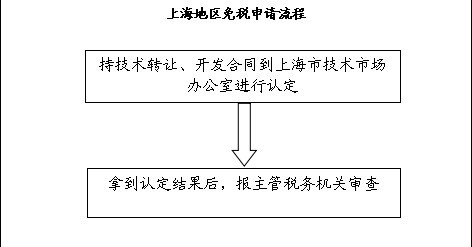
In accordance with the current operational procedures, to apply for tax exemption for foreign enterprises' technology import in Shanghai, the following documents mainly need to be submitted to the competent tax authority:
1. Tax Exemption Application
2. "Tax Exemption Application Filing Form"
3. Original and copy of the business contract for technology transfer, technology development and related technical consulting and technical services
4. "Technology Transfer Contract", "Technology Development Contract" reviewed and stamped with the special seal for technology transfer contract certification of Shanghai Technology Market Office or the special seal for technology development contract certification of Shanghai Technology Market Office and with the reviewer's seal, as well as the original and copy of the technology contract registration certificate
5. Copy of business license and tax registration certificate.
After verifying that the above documents are correct, the tax authority will grant VAT exemption to foreign enterprises for technology import. It is believed that the preferential tax policies for foreign enterprises' technology import after the BT to VAT reform will continue to optimize the international technology import and export environment, promote the development of technology import and export, and further consolidate and enhance Shanghai's leading position as a core city for technology import and export in China.