
Practical Operations for Foreign Exchange Payment in Entrusted Import Agency by Domestic Foreign-Invested Enterprises
Prior to the pilot reform of the verification system for foreign exchange payment under import trade in goods, under agency import business, domestic enterprises acting as the actual buyers could make foreign exchange payments directly to overseas sellers without going through import agents. However, in accordance with the document "Huifa [2012] No. 38" issued by the State Administration of Foreign Exchange, starting from August 1, 2012, all agency import trades nationwide must be paid by import agents, and domestic enterprises are prohibited from making direct foreign exchange payments.
Under the above circumstances, many domestic foreign-invested enterprises often encounter the awkward situation of insufficient RMB funds when importing through agents, making them unable to pay the purchase price to import agents, who then need to purchase foreign exchange for outward payment.
In response, this article will introduce the corresponding foreign exchange payment operation process to resolve the difficulties encountered by domestic foreign-invested enterprises in the process of entrusting agency import payment due to insufficient RMB funds.
I. Impact of Huifa [2012] No. 38 on Agency Import Business
Article 14 of the "Guidelines for Foreign Exchange Administration of Trade in Goods" (Annex I to Huifa [2012] No. 38) stipulates: "Enterprises shall handle foreign exchange receipts and payments for trade in accordance with the principle of 'who exports, who receives foreign exchange; who imports, who pays foreign exchange'... For agency import and export business, the agent shall make payment and receive foreign exchange."
That is to say, for outward foreign exchange payment under agency import business, domestic buyers have only two options: first, pay RMB to the import agent first, who then purchases foreign exchange and makes outward payment; second, directly transfer foreign exchange to the import agent, who then makes direct outward payment.
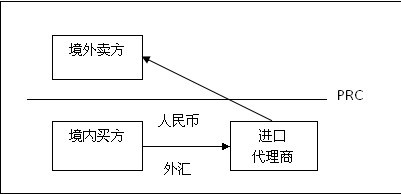
II. Foreign Exchange Payment Operations of Domestic Foreign-Invested Enterprises under Entrusted Agency Import
In practice, many domestic foreign-invested enterprises, especially newly established ones, often lack sufficient RMB funds and thus can only choose to transfer foreign exchange (such as registered capital or foreign currency external debt) to import agents, who then make outward payment.
However, when domestic foreign-invested enterprises transfer foreign exchange to import agents, they often encounter a bottleneck: banks refuse to process the foreign exchange transfer procedures on the grounds of Article 8 of the "Regulations on Foreign Exchange Administration", which prohibits the circulation of foreign currency in China and the use of foreign currency for pricing and settlement. In this case, domestic foreign-invested enterprises are caught in a dilemma: they cannot make direct payments to overseas sellers, have insufficient RMB to transfer to import agents, nor can they directly transfer foreign exchange to import agents, resulting in the agents being unable to make outward payments.
In fact, it is incorrect for banks to refuse to process foreign exchange transfer procedures on the grounds that foreign currency circulation is prohibited in China and foreign currency shall not be used for pricing and settlement. Although Chinese law stipulates in principle that no unit or individual may use foreign currency for pricing and settlement within China, and financial institutions shall not handle foreign exchange transfer procedures for such purposes, this is not an absolute prohibition.
The "Interim Provisions on the Administration of Domestic Foreign Exchange Transfers", which came into effect on October 15, 1997, provides for relevant exceptions to the above situation:
According to the "Interim Provisions", where the principal under agency import is a foreign-invested enterprise, the principal may apply to a financial institution for direct foreign exchange transfer by presenting the following documents:
1. Original agency agreement (stating that the foreign-invested enterprise is the principal and the agency is the agent)
2. "Foreign Exchange Registration Certificate for Foreign-Invested Enterprises" or "Foreign Exchange Account Use Certificate".
After consulting with the relevant functional departments of the State Administration of Foreign Exchange, our above analysis has been verified and confirmed. It is believed that the above practical operation process can provide convenience and reference for foreign-invested enterprises in handling agency import payment business.